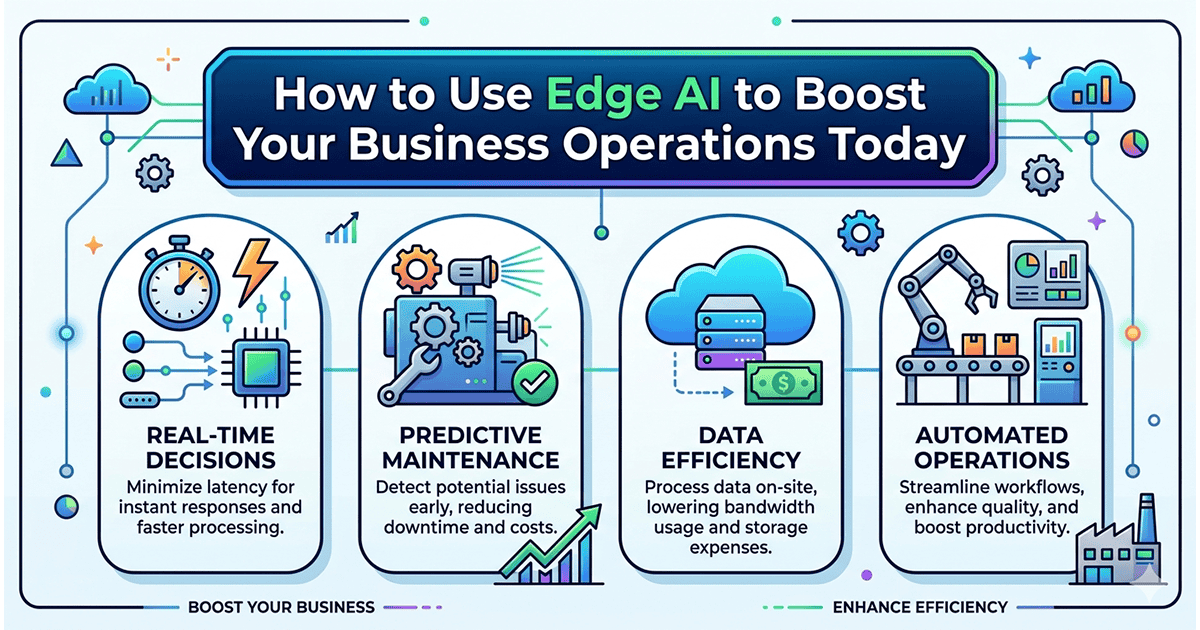


For local business owners, operations managers, and other business decision makers across Africa, the hardest part of staying competitive isn’t ambition, it’s making clear calls while information arrives late, messy, or hard to verify. Business technology trends keep promising “real-time” insight, yet many teams still depend on cloud dashboards that don’t match what’s happening on the shop floor, at the depot, or in the field. That gap quietly drains operational efficiency and turns a data-driven business into a best-guess business. Edge AI is becoming a practical way to bring intelligence closer to the moment work happens.
What Edge AI Means in Plain Language
Edge AI means running AI close to where data is created, instead of sending everything to a faraway cloud first. It usually runs on edge devices like smart cameras, sensors, gateways, POS systems, or rugged mini-computers that sit on-site. Because the processing happens locally, results can come in milliseconds, which is what people mean by low-latency computing.
This matters because delays are expensive. When decisions wait for uploads, dashboards, or shaky connectivity, waste grows quietly. As about 75% of enterprise-generated data will be created at the edge by 2025, learning to act on local signals becomes a real advantage.
Think of it like a security guard who watches the door, not recorded footage hours later. A camera can flag a stockroom intrusion instantly, or a sensor can spot a machine running hot before it fails. That practical speed is why the USD 118.69 billion by 2033 projection is gaining attention.
Build Your Edge AI Plan in Four Practical Steps
Edge AI is easiest to adopt when you treat it like an operations upgrade, not a science project. This quick process helps you choose a realistic first win and speak clearly about it in everyday business terms, which matters when you are tracking fast-moving tech and business shifts.
1. Choose one high-value use case
Start with one problem that costs you time or money weekly, like shrinkage in a stockroom, slow queue times, late deliveries, or unplanned downtime. Pick a use case where a faster local decision changes the outcome immediately, not just a prettier report.
2. Confirm the data source you already have
List what will produce the signals: existing CCTV, POS receipts, machine sensors, GPS pings, or simple temperature and door sensors. Do a quick reality check on access, quality, and frequency, because even a great AI idea fails if the data is missing, inconsistent, or locked in a vendor system.
3. Match the deployment environment to the right edge setup
The Helix 500 Series is a fanless industrial edge computer designed for reliable performance in demanding environments, offering the benefits of localized processing with robust hardware. As a fanless industrial edge computer for demanding environments, it is powered by Intel 10th Gen Core processors and built with a solid-state design to deliver high I/O density and flexible expansion options for edge computing workloads. It’s worth taking a moment to learn more about how its rugged construction and passive cooling make it ideal for deployments where dust, vibration, and continuous operation are key considerations.
4. Plan a small rollout, then scale what works
Run a pilot in one location or one line with two or three success metrics like fewer stock losses, faster decisions, or reduced stoppages. Use the pilot to calculate payback and set a repeatable template, then expand gradually, since the market momentum signaled by the USD 44.73 billion by 2030 projection suggests more tools and vendors will keep entering the space.
See It in Action: 6 Edge AI Wins from Stockrooms to Farms
Edge AI sounds technical, but the wins are very practical: faster decisions, fewer losses, and less “waiting for the cloud” when something is happening right now. Use these examples to pick one high-value use case, confirm your data source, match the environment, and plan a simple rollout.
1. Stop stockouts with “smart reorder” alerts: Start with inventory management automation in one store, stockroom, or depot, one product category only. Put a small edge device where stock is counted (barcode scans, shelf sensors, or even a camera) so it can spot patterns in real time and flag “reorder today” before you run out. The point isn’t perfect forecasting; it’s fewer surprises and fewer emergency deliveries, like the real-world story of AI helping to keep distribution centers stocked.
2. Catch picking and packing errors before they leave the building: If you ship goods, start by scanning or visually checking items at the packing table. Edge AI can compare what’s being packed to the order list immediately, so mistakes are fixed in seconds rather than after a customer complains. Keep it simple: one camera angle, one product type, one shift, then expand once the team trusts the alerts.
3. Use real-time analytics to reroute deliveries on the fly: For logistics optimization, focus on one pain point: late deliveries, fuel spend, or missed drop-offs. An edge system in a vehicle or at a depot can combine GPS, traffic, and delivery scans to recommend “swap stop order” or “hold this parcel” decisions without waiting for a central server. Make it measurable: track on-time rate and average delay for two weeks before and after.
4. Prevent machine downtime with “listen and warn” maintenance: Pick one critical machine (generator, pump, conveyor, milling equipment) and add vibration, temperature, or power sensors. Edge AI learns what “normal” sounds/looks like and flags early warning signs so you can schedule maintenance during planned downtime. This works best when you define the environment up front, dusty shop floor, unreliable internet, hot rooms, so the hardware choice matches reality.
5. Improve quality control right on the production line: If you manufacture or process goods, cameras plus Edge AI can spot defects instantly and trigger a response while the product is still in front of you. Many factories use this approach to spot product defects early, which can reduce waste and rework. Start with one defect type you already track (cracks, wrong label, missing seal) and build from there.
6. Make farms “sense and respond” with smarter field decisions: Smart farming technology doesn’t have to mean expensive, fully automated farms. Begin with one plot and one goal, reduce water use, protect yield, or detect pests, using soil moisture, weather, or simple camera data processed locally for quick action. A practical first pilot is “irrigate only when moisture drops below your target range,” with weekly checks to confirm the model matches what farmers see on the ground.
Edge AI FAQs: Security, Cost, Support, Scaling
Q: What if Edge AI puts my customer or business data at risk?
A: You can design it so sensitive data stays on-site, with only summaries or alerts sent onward. Start by limiting what the device captures, encrypting storage, and setting strict access roles. If you use cameras, consider processing video locally and saving only exceptions, not full recordings.
Q: How much does an Edge AI pilot usually cost to start?
A: A sensible pilot can be small: one device, one workflow, one metric, then expand only if it pays for itself. Your biggest cost is often integration and time, so keep the first test narrow and measure savings weekly. The fact that the global edge AI market is growing fast is a signal that lower-cost options and vendors are increasing.
Q: Do I need a full-time data science team to run this?
A: No. Many businesses begin with a vendor or local integrator, while assigning one internal “owner” who understands the process being improved. Ask for simple dashboards, clear alert rules, and a handover plan so your team can operate it day to day.
Q: When the internet is unreliable, will Edge AI still work?
A: Yes, that is one of its strengths because decisions can happen on the device. Plan for offline mode, queued uploads, and a manual override so work continues even during outages.
Q: Can I scale from one site to many without chaos?
A: Yes, if you standardize early: same data format, the same alert definitions, and a repeatable install checklist. Gartner expects edge computing deployments to use more advanced AI approaches over time, so building a clean foundation now makes expansion easier.
Start a Small Edge AI Pilot for Future‑Ready Business Operations
It’s easy to feel stuck between rising pressure to modernise and real worries about security, costs, and support. The way forward is a steady mindset: start small, choose one clear use case, and let a pilot guide your Edge AI journey with learning you can trust. When that happens, Edge AI adoption motivation becomes practical, and business innovation stops feeling like an expensive leap. Edge AI works best when you begin with one small, measurable win. Choose one process this week and run a simple pilot, then review what improved and what needs adjusting. That’s how technology empowerment turns into future-ready operations built for resilience and growth.
Stay informed and inspired with Sabon News, where every story is crafted to bridge gaps and foster empathy across our global community.