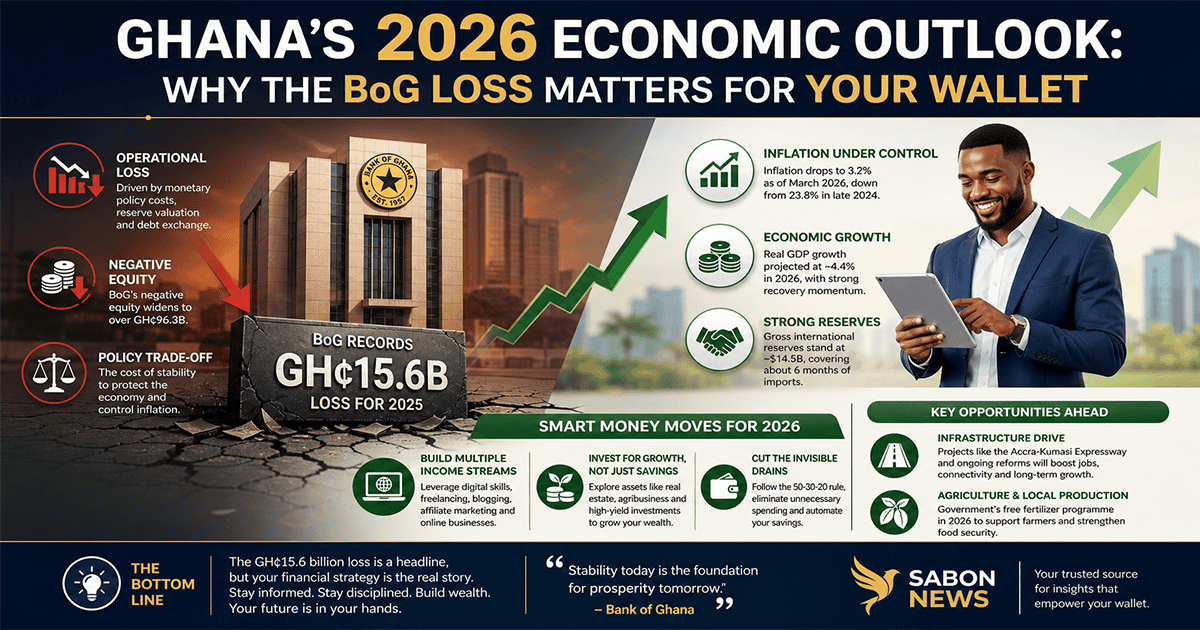

Ghana’s 2026 economic outlook is currently dominated by one headline that has likely caught your eye: the Bank of Ghana (BoG) has officially recorded a GH¢15.6 billion loss for the 2025 financial year. While big numbers like “billions” can feel abstract, they actually tell a very personal story about the money in your pocket.
At Sabon News, we believe that understanding the “why” behind these big shifts is the first step toward protecting your own hard-earned wealth. Let’s break down exactly what these changes mean for your financial future.
The Real Story Behind the Loss Ghana’s 2026 Economic Outlook
In its latest audit released on May 1, 2026, the central bank confirmed an operational loss of GH¢15.6 billion, a significant 65% jump from the previous year. While this sounds like a failure, it is actually a defining moment for Ghana’s 2026 economic outlook. Supporters of the bank’s policy argue this loss was essentially the “cost of stability” a strategic move to rescue the currency.
The proof? Inflation has taken a massive dive, falling from a painful 23.8% in late 2024 to a remarkably steady 3.2% as of March 2026. The bank essentially spent its own money to keep the cedi stable and prices low for the average consumer. However, critics aren’t as optimistic, calling this a “new low” that leaves the bank with a staggering GH¢96.3 billion in negative equity, raising long-term questions about how sustainable this path really is.
Why You’re Still Feeling the Pinch
If inflation is down to 3%, why does everything still feel expensive? It comes down to a few global and local “shocks” hitting us all at once:
- The Global Fertilizer Spike: The World Bank has warned of a 30.7% surge in global fertilizer prices this year. Because Ghana’s economy relies so heavily on farming, this spike makes it more expensive for farmers to grow food, which eventually leads to higher prices for you at the local market.
- The Return of Debt Servicing: Now that our debt restructuring is behind us, Ghana is back to paying its international debts in full. This puts a massive strain on our foreign reserves, making it harder for the central bank to keep the cedi as strong as it was last year.
- Fuel and Global Unrest: Tensions in the Middle East specifically, around the Strait of Hormuz continue to make global fuel prices jump. When oil gets expensive there, we feel it at our local pumps here in Ghana almost instantly.
Smart Money: How to Stay Ahead in 2026
You can’t control the Bank of Ghana, but you can control your own strategy. Here are three practical ways to protect your finances right now:
- Build Your “Digital Safety Net”: In 2026, a single salary isn’t enough. The most resilient Ghanaians are those building multiple income streams. Whether it’s affiliate marketing, freelancing, or starting a niche blog, having “digital real estate” that pays you in your sleep is no longer a luxury it’s a necessity.
- Trade Consumption for Growth: With Treasury Bill rates falling alongside inflation, keeping all your cash in a basic savings account is a losing game. Look toward growth-oriented assets like real estate or high-yield agribusiness. If things get expensive, you want to be the person owning the production, not just the one paying for it.
- Find Your “Invisible Drains”: Small costs add up. Audit your monthly spending for forgotten subscriptions or high data costs. The classic 50-30-20 rule (50% for needs, 30% for life, 20% for the future) is still the best way to ensure you are consistently building a future, no matter what the headlines say.
Looking Forward
Despite the debate over the BoG’s losses, there are bright spots. Major infrastructure projects like the Accra-Kumasi Express Road are moving forward, and our banking sector is showing real signs of life again. The government is also shifting toward free fertilizer distribution in 2026 to help offset those rising global prices.
The Bottom Line: The GH¢15.6 billion loss is a headline, but your personal financial strategy is the real story. Stay disciplined, stay curious, and keep checking Sabon News for the insights you need to thrive.
Ready to take the next step?
If you want to set up a professional blog or need expert SEO strategies to grow your website in this economy, contact us today. We’ll help you turn these economic trends into your own personal success story.