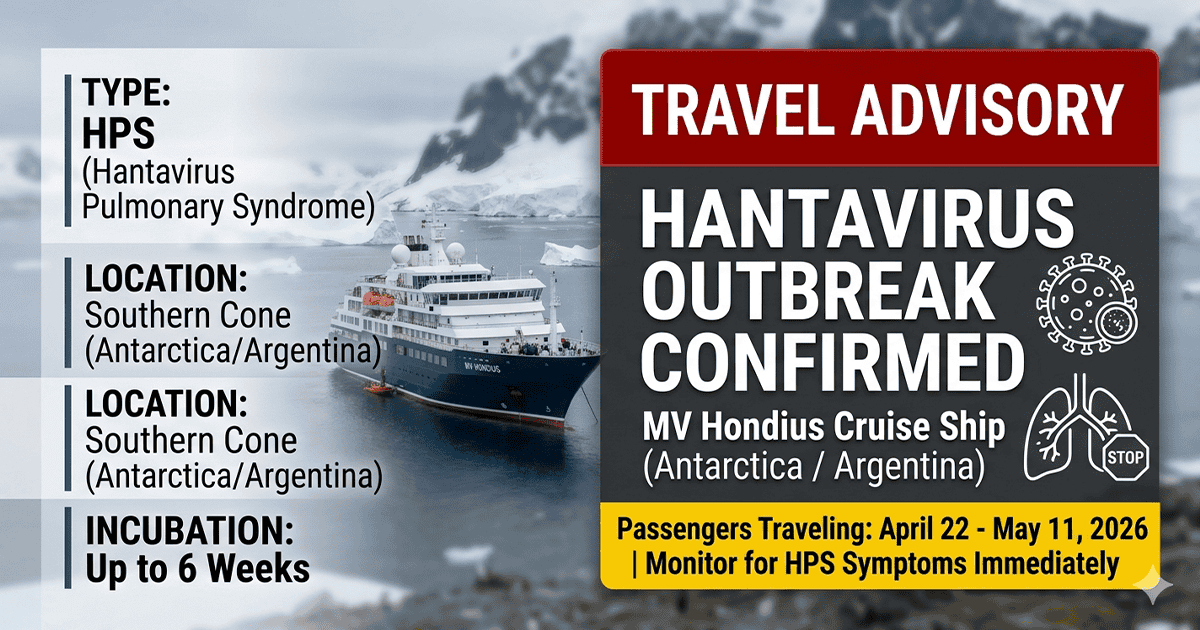

If you have a vacation booked this year, recent international health headlines might have you second-guessing your itinerary. Global health agencies are currently tracking a rare infectious hantavirus outbreak tied directly to a luxury cruise vessel operating in the South Atlantic. While the word “hantavirus” usually brings to mind rural cabins and dusty barns, this specific situation has sparked urgent international concern.
The reason for the alarm? The culprit is the Andes virus strain, a rare variant that does something most other hantaviruses cannot: it spreads directly through person-to-person transmission. This unique trait has instantly transformed a localized outbreak into a major talking point for global health monitors and everyday travelers alike.
The MV Hondius Incident: What Actually Happened?
The current cluster of infections began aboard the MV Hondius, a Dutch-flagged cruise ship known for taking travelers to some of the most remote corners of the planet. The voyage started in Ushuaia, Argentina a popular launching pad for Antarctic tourism and carried 147 passengers and crew.
[Ushuaia, Argentina] ➔ [South Georgia Excursions] ➔ [Saint Helena] ➔ [Medical Emergency]
Before a medical emergency was officially declared, the ship made stops in South Georgia and Saint Helena. According to the latest tracking data from the World Health Organization Emergencies Page, the current toll stands at 11 confirmed and probable cases, which have tragically resulted in three deaths.
Epidemiologists believe the infectious hantavirus outbreak started during shore excursions in South America, where passengers were likely exposed to infected wild rodents. Because hantavirus symptoms can take anywhere from one to six weeks to appear, many travelers didn’t get sick until the ship was deep into its journey, or after they had already flown home.
The Science of Human-to-Human Spread
To understand why public health officials are moving so quickly, you have to look at how the Andes virus behaves. Most hantaviruses, like the Sin Nombre virus found in North America, are a dead-end in humans. You can catch them from breathing in dust contaminated by rodent droppings, but you cannot pass it to your family.
The Andes hantavirus rewrites those rules. Health officials have confirmed that this strain can become aerosolized, traveling through tiny droplets in the air during close, prolonged contact. On a cruise ship a closed environment with shared social spaces and interconnected ventilation the risk of this kind of spread naturally goes up.
However, experts listed in the ECDC Outbreak Q&A stress that general readers should not panic. This is not a highly contagious respiratory disease like COVID-19 or influenza. It requires very specific, sustained, close-contact conditions to pass from one human to another.
A Massive International Containment Response
The global effort to contain this virus has been highly aggressive. According to situational updates from the European Centre for Disease Prevention and Control (ECDC), a coordinated multi-country response has been deployed to ensure the outbreak doesn’t turn into a secondary wave of infections:
- Emergency Air Evacuations: Critically ill patients were airlifted directly from the ship to specialized high-isolation Intensive Care Units in South Africa, Switzerland, and the Netherlands.
- Mandatory Isolation: Passengers who disembarked in the Canary Islands were immediately placed on chartered flights back to their home countries—including Canada, France, and Germany—to complete strict monitoring windows.
- Aviation Contact Tracing: The CDC and the UK Health Security Agency are actively tracking commercial flight manifests to identify anyone who sat near symptomatic passengers on their journeys home.
Spotting the Symptoms: Hantavirus Pulmonary Syndrome
Because there is currently no specific antiviral treatment or vaccine for the Andes virus, early detection is the only way to survive. Doctors have to rely entirely on early hospitalization and supportive care, such as intubation and oxygen therapy, to help the body fight off the infection.
For everyday people, knowing the two distinct stages of Hantavirus Pulmonary Syndrome (HPS) is vital:
- The Early Phase (Days 1–5): This looks like a standard flu. Patients experience a sudden high fever, chills, severe muscle aches (myalgia) in the thighs and back, and gastrointestinal issues like nausea or vomiting.
- The Critical Phase: The virus attacks the lungs. Patients experience a terrifyingly sudden onset of shortness of breath and coughing as their lungs begin to fill with fluid.
Should You Change Your Travel Plans?
Despite the scary headlines, the actual risk to the general public remains incredibly low due to strict geographic realities.
The primary carrier of this virus is the long-tailed pygmy rice rat, a species entirely confined to South America. It cannot survive or breed in the wild in Europe, North America, or Asia. Once the passengers from the MV Hondius finish their isolation periods, the risk of the virus spreading in these regions is virtually zero.
If you are planning an upcoming trip to the “Southern Cone” of South America (specifically rural Chile and Argentina), you can protect yourself with safety basics highlighted on the WHO Hantavirus Fact Sheet:
- Stick to modern, well-ventilated hotel accommodations.
- Avoid cleaning, sweeping, or sleeping in old, dusty, unventilated cabins or storage sheds.
- Keep all food sealed in airtight containers to keep local rodents away.
Looking Ahead
As the MV Hondius heads back to Europe for a comprehensive deep-cleaning and disinfection process, global health authorities are turning their attention to long-term surveillance. This outbreak is a powerful reminder of how quickly a localized animal virus can go global in our interconnected world. By studying this incident, scientists hope to get closer to developing a permanent vaccine for these rare but deadly pathogens.
Frequently Asked Questions (FAQ)
Can hantavirus spread from person to person?
Yes, but only specific strains. While most hantaviruses only spread from rodents to humans, the rare Andes virus strain can spread between humans through close, prolonged contact via aerosolized droplets.
What are the first signs of a hantavirus infection?
The early symptoms of Hantavirus Pulmonary Syndrome (HPS) mimic the flu. They include a sudden high fever, severe muscle aches (myalgia) in the thighs and back, chills, headaches, and gastrointestinal issues like vomiting or diarrhea.
Is it safe to go on a cruise during the 2026 outbreak?
Yes. The outbreak is isolated to a single vessel (MV Hondius) following specific shore excursions in rural South America. Global health agencies have successfully contained the passengers, and the general risk to international cruise travelers remains extremely low.
How do you prevent hantavirus while traveling?
If you are traveling to endemic areas in South America, avoid dusty, unventilated buildings, cabins, or storage sheds. Stay in modern accommodations, practice strict hand hygiene, and ensure all food is stored in airtight, rodent-proof containers.
Stay informed and inspired with Sabon News, where every story is crafted to bridge gaps and foster empathy across our global community.