
The outcry across Ghana’s tech ecosystem isn’t just standard internet pushback it is a fundamental clash of cultures. On one side is a traditional, top-down bureaucratic governance model; on the other is a fast-moving, merit-first digital economy.
While the Ministry of Communications and Digital Technologies is right to prioritize data sovereignty and national cybersecurity, the current draft of the NITA Bill uses a sledgehammer where a scalpel is needed. If passed without major revisions, it risks dismantling Ghana’s reputation as West Africa’s most promising tech hub.
What is the NITA Bill and Why the Sudden Outrage?
The core objective of the new legislation is to upgrade NITA from an administrative coordinating body into an all-powerful digital-sector regulator. The proposed authority would gain sweeping control over Ghana’s entire tech landscape including cloud hosting, software development, local tech talent, IT infrastructure installation, and data centers.
The state’s argument is straightforward: a modern digital economy requires strong legal foundations, cybersecurity standardization, and interoperability to prevent vendor lock-in. However, the tech community argues that the draft takes a heavy-handed, bureaucratic approach that completely misinterprets how the global tech economy actually operates.
Here is a professional analysis of where the legislation misses the mark, where the state has a point, and how both sides can reach a realistic compromise.
The Three Fatal Disconnects
The core issue with the draft bill is that it misinterprets how the global tech economy actually operates. Three specific provisions are causing the most alarm.
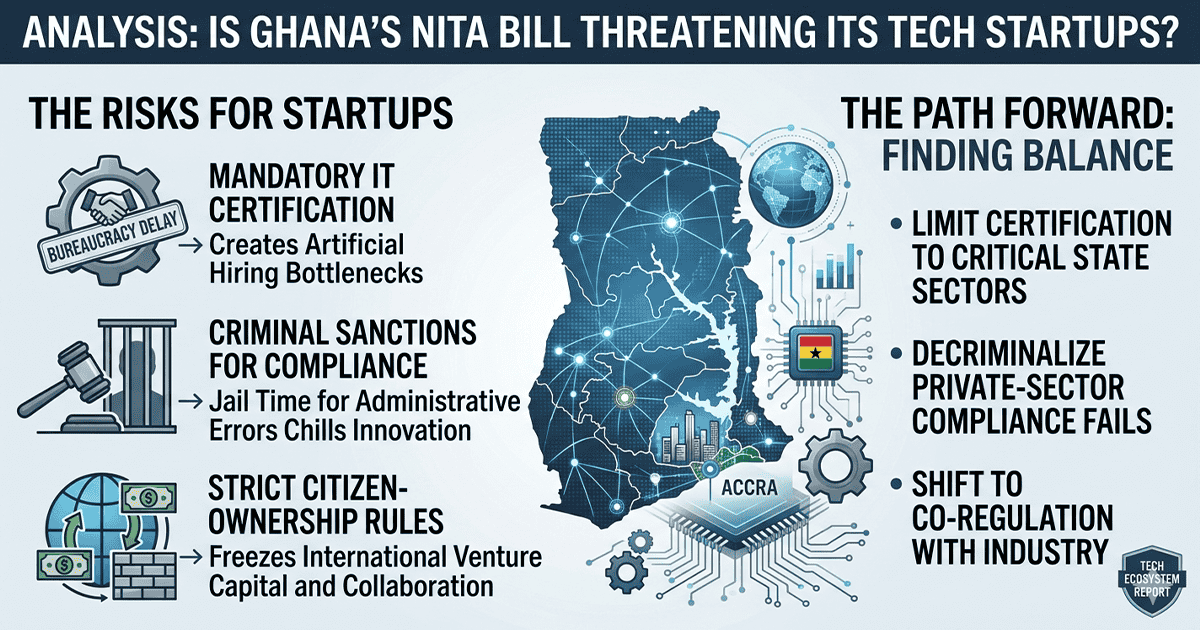
1. The Certification Trap (Section 46)
The NITA bill attempts to mandate that anyone working as an ICT professional in either the public or private sector must be certified by NITA.
This completely ignores the reality of modern software engineering. Tech is a pure meritocracy. Some of the region’s most brilliant developers, network architects, and data engineers are entirely self-taught, relying on bootcamps, open-source projects, and hands-on experience. Forcing private companies to filter talent through a government administrative stamp creates an artificial bottleneck. You cannot treat writing code like practicing corporate law or medicine; it stalls the hiring pipeline in an industry that moves at lightning speed.
2. Criminalizing Compliance (Sections 35 & 36)
Under these sections, cloud providers, data centers, and local Software-as-a-Service (SaaS) startups must secure a NITA license to operate.
Regulating data architecture is standard practice globally, but the draft takes a dangerous turn by introducing criminal sanctions. Threatening founders with six months to two years of prison time for regulatory or administrative paperwork errors will completely paralyze early-stage innovation. Tech startups survive by building fast, testing products, and pivoting. When the penalty for an administrative oversight is jail time, entrepreneurs simply won’t take the risk.
3. Starving the Ecosystem of Capital (Section 37)
The draft suggests that certain ICT licenses may be restricted to businesses that are “wholly owned by a citizen.”
While local empowerment is a noble goal, it is economically blind to how tech ecosystems scale. Local capital pools in Ghana are rarely deep enough to sustain high-growth tech companies. Startups require international venture capital, foreign seed funding, and cross-border partnerships to survive past their first two years. If rigid structural walls are built around foreign equity ownership, international investors will not wait around they will simply move their capital to more flexible regulatory environments like Kenya, Nigeria, or South Africa.
Assessing the State’s Perspective
To find a way forward, it is important to acknowledge that the government isn’t operating entirely in bad faith. Regulators worldwide are scrambling to secure national digital borders. The state has a legitimate, pressing duty to:
- Protect citizen data from cross-border breaches.
- Secure critical state infrastructure (like national identity systems and fintech rails).
- Prevent vendor lock-in that drains public funds.
In fact, portions of the bill specifically Section 60’s introduction of a Regulatory Sandbox prove that sophisticated, forward-thinking policy minds were involved in the drafting process. The sandbox model is an excellent framework that allows startups to test innovative products under relaxed regulatory supervision.
The Path Forward: Regulating Risk, Not Innovation
Ghana does not have to choose between a digital “Wild West” and a bureaucratic stranglehold. Smart tech policy focuses on regulating the risk, not the dream.
A pragmatic, industry-backed compromise is entirely achievable if the Ministry returns to the drawing board with three specific revisions:
The Three Essential Fixes:
- Narrow the Scope of Certification: Limit mandatory NITA certification strictly to high-stakes public sector roles, defense contracting, and critical state data infrastructure. Leave private-sector hiring entirely to the free market, where talent is judged by practical capability.
- Decriminalize Administrative Errors: Replace prison sentences for private-sector tech compliance failures with a tiered system of civil penalties, administrative warnings, and proportional fines. Early-stage, pre-revenue startups should be entirely exempt from heavy licensing fees.
- Shift to Co-Regulation: Instead of a top-down government mandate, NITA should collaborate with local tech associations (like the Ghana Chamber of Technology) to establish voluntary competence frameworks and recognize globally established standards (like ISO or SOC 2 certifications).
You cannot successfully run national “one million coders” initiatives while simultaneously passing laws that make it a liability to hire them. Regulators must actively listen to the builders on the ground. The goal of the NITA Bill should be to build a secure framework that protects consumers without suffocating the very startups driving Ghana’s digital future.
What do you think about the proposed NITA Bill? Does Ghana need strict state regulation to protect consumers, or will this law choke local tech startups out of existence? Let us know your thoughts in the comments below!
Stay informed and inspired with Sabon News, where every story is crafted to bridge gaps and foster empathy across our global community.