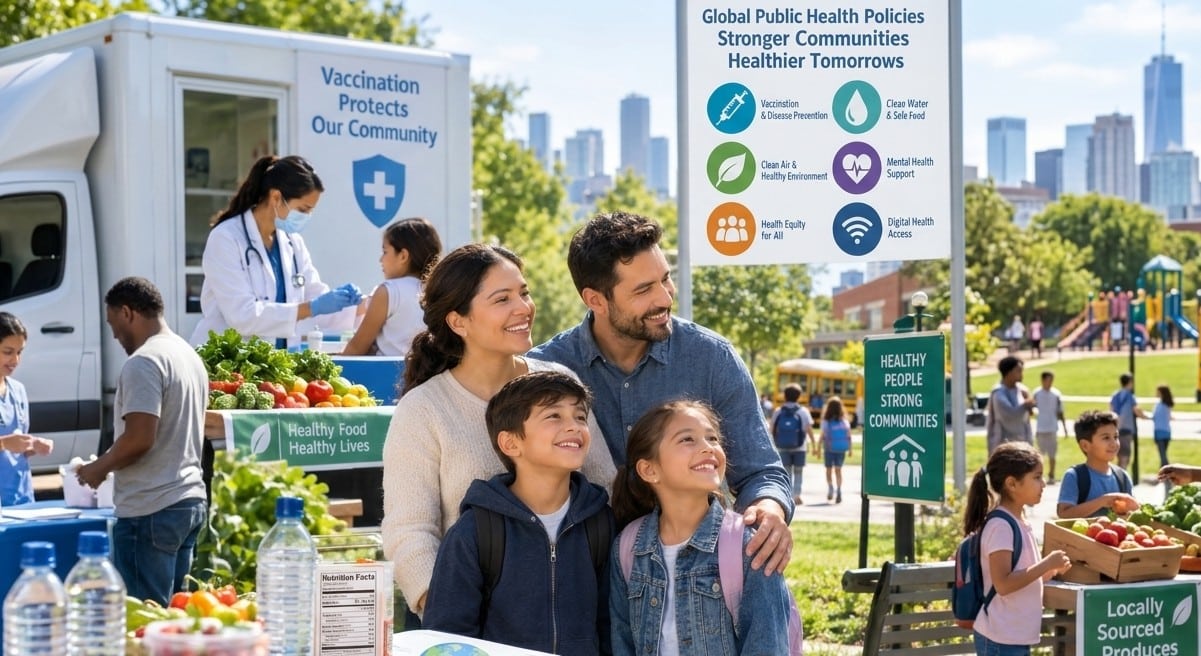


What does your morning routine look like? Probably something like this: you brush your teeth with tap water, send your children to school without worry about whether they’ll catch a preventable illness, eat breakfast and check the nutrition facts label, walk by a food establishment that’s inspected by your state, and breathe regulated air.
Now, imagine you’re in a country where any or all of these safety measures do not exist. Which do you think would be easier? Figuring out which public health policies work, or figuring out which policies don’t work? That’s exactly the point. Most of the time, we don’t even realize public health policies exist until something breaks. Those policies usually stem from global agreements, research, and collaboration.
This article discusses the global public health policies that govern our everyday lives and how familiarity with these policies allows for stronger and healthier communities.
Global public health policies do not usually come as a single law. They usually come as a series of layers. International organizations come up with standard, evidenced-based frameworks and guidance. Countries adapt them to national laws and policies. The frameworks then trickle down to local levels to be carried out as clinics, inspections, information, education, communication activities, and school programs. By the time policies get to you, they are in the form of a free flu shot or a sign that says ‘No Smoking.’
It is important to understand how policies get to us so we can strategize how to get policies to where they are most needed. Pollution and misinformation have no boundaries. There are good examples of global systems where information gets to where it is needed fast. An outbreak anywhere is an outbreak everywhere. When a system works, it is used to add additional protection against polio, or to shut down measles outbreaks.
Prevention is the Best Medicine
The best examples of policy success are prevention, and vaccination policies. A concerted global effort to eliminate smallpox was successful and polio is on the verge of eradication. The best way to protect children from measles is to keep immunization campaigns strong and reach as many children as possible.
Some visible effects of vaccination policies are requiring students to be vaccinated prior to school admission, or vaccination of infants and young children, and policies that restrict international travel without proper health protection. Ultimately, vaccination policies and herd immunity help shield people that are most vulnerable and cannot be protected by vaccination, like newborns or cancer patients.
Prevention is broad.
- Screening programs identify conditions like high blood pressure and certain cancers before symptoms appear.
- Changes to how the tobacco industry is regulated have been useful. So, too, have been restrictions on tobacco advertising, health warnings, and the establishment of smoke-free environments.
- Food labeling and dietary guidelines empower families, while encouraging the food industry to change the products they manufacture and market.
- Purchase and adhere to regulations aimed at road safety. Seat belt and child safety seat laws, for example, and obeyed speed limits, help save lives.
So do all of these tactics, combined, and quickly. The burden on the health care system is reduced and the wait time for all of us is shortened.
Clean water, safe food, and a healthy environment are essential. Healthy food and water contribute to health like little else in history. Where it exists, diarrheal diseases and cholera are uncommon. Children suffer and die most when it is absent.
Achieving the United Nations Sustainable Development Goals means funding and prioritizing education on personal hygiene and health, as well as providing clean water and sanitation.
When it comes to international norms and standards related to food safety, it feels like we have this quietly working behind the scenes. International standards impact how we produce, store and transport food. If something is contaminated it gets traced and pulled from the supply chain. Most of us don’t really think about this system when we go to the grocery store, and that’s a good sign that the system is working.
Air quality and climate policy feel like the newer frontiers. Pollution from factories and bus exhaust make it harder for kids to play outdoors, exacerbate asthma, and can contribute to heart disease. There are a myriad of policies to protect health and reduce pollution. As a result, some communities are less stressed and more connected. Changes to air quality change how people in a community move, engage, and function.
Mental health is starting to be part of the public health discourse. One of the consequences of eroding mental health is feelings of loneliness and social isolation which has a spill over effect on work and family life. There is a desire, and momentum, to move from reactive, private response to mental health issues to a more active and public strategy.
New, better coordinated approaches to mental health are focusing on early intervention to mitigate stigma and improve access to care. The practical results can be seen in more and better employee assistance programs and a myriad of community based mental health supports.
Digital policy has expanded the door even further. Many countries rapidly changed their telehealth policies in recent years, and it’s now possible for people in rural areas or urban areas to connect to a virtual psychiatrist from the comfort of their home, without taking a day off work or enduring long wait times for in-person appointments.
Policy changes should be comprehensive and include protections for patient privacy. Standardizing licensure and fair reimbursement would ensure that quality mental health services are within reach for all members of the community. Community mental health services should be comparable to family practice services.
Focusing on Health Equity
Even the best policy fails if it only reaches some people. “Health Equity” is the belief that everybody should have the opportunity for good health. The idea has gained tremendous traction in public health.
Of course, vaccination campaigns and health promotion/disease prevention efforts are futile if only a small portion of the community is engaged, or if people have to travel unreasonable distances to get care. Making healthy choices requires resources, and the resources often depend on social class. Health status and mental health are significantly impacted by geography, class, and education. These factors are known as the “Social Determinants of Health.”
In order to address some of the discrepancies in health equity, there are measures communities can take including:
- Community leaders and local faith-based organizations are often first to identify community challenges, including barriers to health care.
- Using trusted messengers. People are more inclined to trust and act on health information when delivered by a person that they already view as trustworthy.
- Making services more accessible. There are a variety of ways to lower the barriers to accessing health services. Mobile clinics, evening or weekend hours, and the use of various media and formats (including traditional and digital) are some methods that help to reach a wider audience.
- Determining who is left out. Unless you have the data to show which groups are being left out, improved policies are often general and lack impact. Improving policies that impact equity are the key to making positive changes to the lives of people we serve.
- Equity is imperative. This is what elevates an average or good policy to a great policy.
What You Can Do as an Individual
As an individual, global public health policies may feel out of reach. However, this is far from the truth. There are many policy changes at the local level that you can play a part in and which help to improve the health of your community. These include advocating for easy access to health and other social services, and for other health and social policy changes at the local level (e.g., for clean air and water, or for healthy and safe environments). You can take part in health and social services meetings at the local level to create awareness and advocate for easy access to health services and other social services.
There are little things we can all do to create a culture of care. Some examples include checking the accuracy of health-related news and information you wish to share before disseminating it, and checking in on the isolated neighbor.
Conclusion
Global public health policies are the reason your water is safe, your food is inspected, your children are protected from preventable diseases, and your community is slowly getting better at talking about mental health. They work best when people understand them and defend them.
The next time you notice something that ‘just works’ like a clean park, a clinic with ample supplies, or a free screening, stop to consider what policy is behind it. Once you figure it out, defend it.
Author:
Sara William, a digital marketing consultant, writer, freelancer, WordPress enthusiast, and coffee lover.