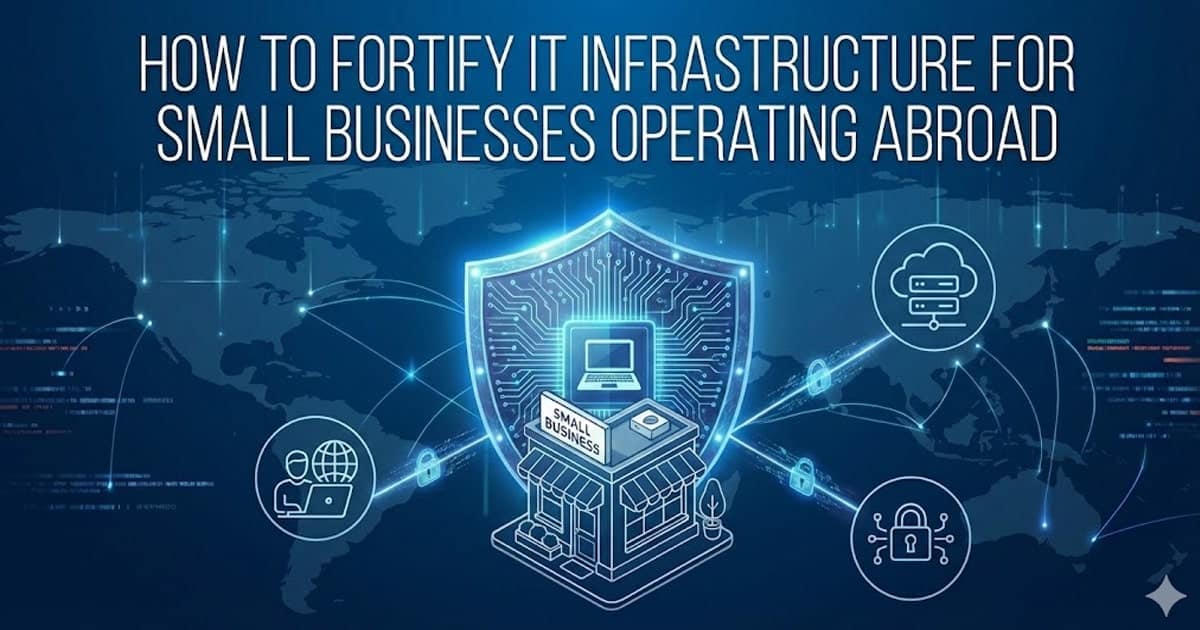


In unpredictable markets, infrastructure tells the real story. Not logos, not offers. When energy costs spike, vendors pull back, or compliance shifts mid-quarter, the systems underneath a business determine whether it bends or breaks. Outside the U.S., those shifts tend to move faster, hit harder, and arrive with fewer warnings. Yet many small businesses still treat infrastructure like a checklist — a firewall here, a backup there — instead of what it has become: a live environment, reactive and consequential. The question isn’t whether the storm arrives. It’s how the structure holds when it does.
Know the Terrain Before Pouring Concrete
Businesses often bolt on tools, mistaking motion for clarity. But visibility — the honest kind, where system dependencies are laid bare — is what keeps things upright. It starts with understanding where control lives in the system and where it slips through cracks. For example: if a sales dashboard lags, is it the UI? The database? The vendor’s sync API? Without structural context, every glitch looks the same — and infrastructure decisions degrade into guesswork. Monitoring isn’t just a security function. It’s an act of orientation.
Continuity Means Accepting What Breaks
There is no such thing as flawless uptime. Pretending otherwise leads to brittle architecture. What matters is whether individual failures take everything else down with them. Businesses that persist through disruption tend to design for partial function — workflows that limp, reroute, delay gracefully. Not pretty, but operational. Practices built around keeping core operations active under stress reduce panic, not just downtime. The goal isn’t to make things unbreakable. It’s to make breaking survivable.
Knowledge Insulates, Even When Systems Don’t
There comes a point where the infrastructure is fine, but the leadership is unsure. That’s the moment decisions slow, options narrow, and hesitation costs more than failure. One of the most underrated ways to harden a company is by embedding that confidence early. Pursuing a cybersecurity degree online may seem academic, but it offers business leaders a practical lens for threat modeling, data governance, and strategic tooling — especially useful when operating in jurisdictions without predictable enforcement norms. Skill doesn’t guarantee safety, but it reduces dependency.
Cloud Doesn’t Mean Resilient by Default
Just because it’s hosted elsewhere doesn’t mean it’s safe. Cloud adoption moves fast — often faster than strategy can catch up. A surprising number of outages stem not from the cloud itself, but from misaligned implementation. Businesses that last begin by framing the cloud around specific business goals, not generic availability claims. That means asking hard questions: which processes actually need elasticity? Which don’t tolerate latency? Which workloads might require sovereign data zones in the future? When the cloud becomes a mirror of the company’s actual needs, not someone else’s best practices, resilience follows.

Rigid Systems Don’t Break — They Shatter
One update. One new jurisdictional rule. One unexpected growth spike. If those things force a full rebuild, then the structure wasn’t stable — it was stuck. Businesses operating across uncertain terrain tend to rely on modular frameworks that expand sideways, not just upward. This approach allows individual pieces to change without destabilizing the whole. A pricing engine can update without affecting fulfillment logic. A vendor integration can pivot without gutting inventory sync. Modularity turns infrastructure into a series of movable parts — and with that comes maneuverability under pressure.
Systems Behave Differently When Humans Aren’t Trained
Not every infrastructure failure is technical. Often it’s procedural. A mis click on a phishing link. An employee using personal email to transmit client data. These aren’t moral failings — they’re signals of systemic oversight. That’s why the infrastructure conversation has to include behavior. Teams that have internalized baseline cybersecurity hygiene — recognizing spoofed domains, using password managers, understanding file permission limits — become part of the system’s stability layer. Infrastructure without that layer invites quiet breakdowns that don’t show up in logs… until they do.
Continuity Planning Isn’t a Form, It’s a Stress Test
What would actually happen if the server in question died at 2:17am on a Tuesday? Would the regional manager know who to call? Would the secondary access credentials work? This is the substance of real continuity planning — not the template in a folder, but the dry run that reveals gaps. Especially for business owners abroad, mapping out continuity protocols requires acknowledging power outages, unstable vendor ecosystems, and inconsistent policy enforcement. Plans built only for ideal conditions tend to unravel when met with anything less.
The systems that hold in turbulence aren’t always the flashiest or the newest. They’re the ones built with uncomfortable questions in mind. What fails first? What happens next? Who decides under constraint? In international environments, where guarantees are fewer and pressure points sharper, those questions take on weight. Infrastructure isn’t just a technical layer. It’s a map of what the business believes about risk, about control, about human error. Strong maps don’t eliminate uncertainty — they make it navigable.
Stay informed and inspired with Sabon News, where every story is crafted to bridge gaps and foster empathy across our global community.